
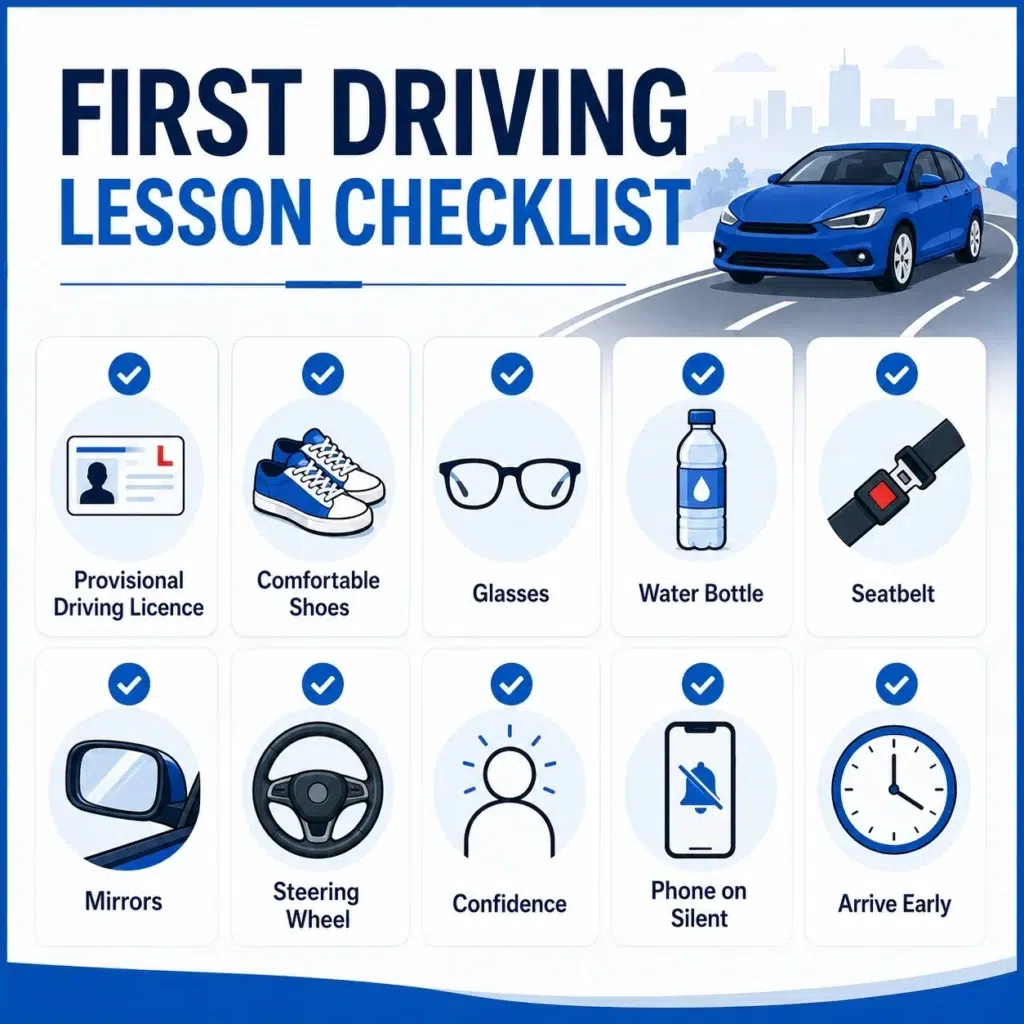
Quick answer: For your first driving lesson, bring your provisional licence, glasses if needed, and flat, grippy shoes. Arrive 5–10 minutes early. Most first lessons last 1–2 hours, and around 80% of that time is spent actually driving — usually starting on quiet residential roads within the first 10–15 minutes.
Nerves before a first lesson are near-universal — instructors report almost every beginner asks the same handful of questions. This guide answers them directly, with a real minute-by-minute breakdown of what happens, not just generic reassurance.
Table of Contents
Legal Requirements Before Your First Lesson
Before your instructor even starts the engine, three legal boxes must be ticked:
- Age: You must be at least 17 years old — or 16 if you receive the higher rate mobility component of PIP (Personal Independence Payment)
- Provisional licence: You must hold a valid UK provisional driving licence
- Eyesight: You must be able to read a number plate from 20 metres away — wear glasses or contacts during the lesson if you need them for this
Some instructors also ask for a DVLA “check code“ as an extra verification step alongside your physical licence — you can generate this free at gov.uk’s “view driving licence” service if requested.
What to Bring: The Non-Negotiables
| Item | Why It’s Required |
|---|---|
| Provisional driving licence (physical card) | Legally required — your instructor cannot let you drive without checking it first |
| Glasses/contacts (if needed for driving) | Legal requirement to read a number plate at 20 metres |
| Flat, grippy shoes | Trainers or flat shoes give accurate pedal feel; avoid heels, flip-flops, thick boots |
| Water | Lessons run 1–2 hours; staying hydrated helps concentration |
| Notebook and pen | Jotting down feedback immediately after the lesson helps retention far more than trying to recall it later |
| Phone on silent | Removes the single biggest avoidable distraction in the car |
Without your provisional licence, the lesson legally cannot go ahead — this is the one item that will get you turned away, so check it’s in your bag the night before, not the morning of.
What to Wear
| Wear | Avoid |
|---|---|
| Trainers or flat shoes | High heels |
| Comfortable trousers | Loose sandals or flip-flops |
| Lightweight layers | Bulky coats (restrict shoulder movement for mirror checks) |
| Weather-appropriate jacket (removable) |
Minute-by-Minute: What Actually Happens in Lesson One
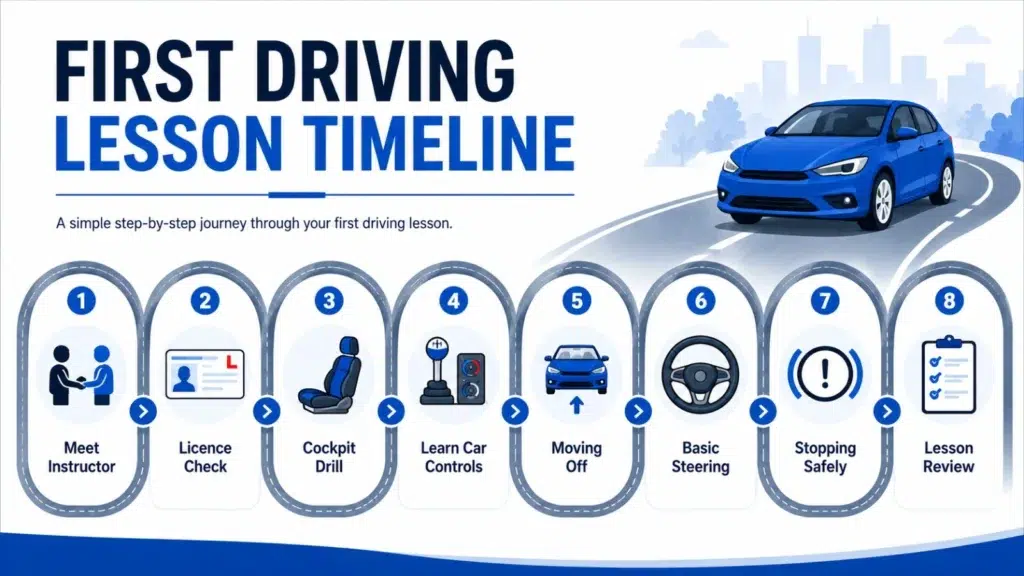
Most first lessons follow this structure closely:
Minutes 0–10: Introduction and licence check
- Instructor confirms your provisional licence
- Explains how the lesson will run
- Walks you through the cockpit drill — the standard pre-drive safety routine every UK learner is taught, remembered with the acronym DSSSM:
- Doors – properly shut and secured
- Seat – adjusted so you can reach the pedals comfortably with a clear view
- Steering – correct grip and safe distance from the wheel
- Seatbelt – fastened securely
- Mirrors – rear-view and both side mirrors adjusted for maximum visibility
This routine usually takes under 10 minutes and is repeated at the start of every lesson, not just your first.
Minutes 10–25: Controls, not driving yet
- Steering, indicators, brake, and accelerator explained
- Manual learners: clutch and gear basics introduced here
- This is the densest information block — instructors expect you to forget some of it, and will repeat it
Minutes 25–60+ (remaining lesson time): Actual driving
- Almost always starts on a quiet residential road
- Core skills practised: moving off, steering around bends, stopping safely, mirror checks, basic junction awareness
- This means roughly 60–75% of a 1.5-hour first lesson is spent physically driving, not sitting and listening
Direct answer to “will I actually drive on lesson one?” — Yes. The vast majority of learners are driving within the first 15 minutes of their first lesson, contrary to the common assumption that lesson one is mostly theory.
Steering position: Your instructor will show you the standard “10 and 2” or “9 and 3” hand position on the wheel — this gives full control and quick reaction time without restricting your view of the dashboard.
How the lesson ends: Once your short route is finished, your instructor will guide you to a safe spot to pull over, apply the handbrake, and switch off the ignition. You’ll then swap seats, and the instructor drives you back to where the lesson started (or drops you home, depending on how it was arranged) — you are not expected to drive yourself back at this stage.
Common First-Lesson Mistakes (And Why They’re Normal)
| Mistake | Root Cause | Fix |
|---|---|---|
| Forgetting mirror checks | Attention fixed on steering | Build a fixed “Mirror → Signal → Manoeuvre” sequence from lesson one |
| Stalling (manual) | Releasing clutch too fast | Practise the biting point stationary before moving off |
| Steering too late into a turn | Looking too close to the bonnet | Look 10–12 seconds ahead, not directly in front of the car |
| Braking too hard | Nervous over-correction | Apply gradual, progressive pressure rather than a single stomp |
| Driving too slowly | Low confidence, not lack of skill | Instructor will set a target speed for the road type |
Every one of these is expected by instructors on lesson one — none of them indicate you’re “bad at driving.” They’re the standard early-stage errors that disappear with repetition.
Mental Preparation: What Actually Helps
- Sleep and food matter more than confidence tricks. A well-rested, fed learner concentrates better than an anxious but “pumped up” one.
- Arrive 5–10 minutes early, not right on time — rushing in adds stress before the engine even starts.
- Compare yourself only to your own last lesson, not to other learners — DVSA data shows lesson counts to test-ready standard vary widely (many pass between 30–50 hours; some need more, some less).
Manchester-Specific Notes for Lesson One
- Most Manchester driving schools start learners on quiet streets in areas like Chorlton, Withington, or Sale before introducing busier roads.
- Manchester’s changeable weather means you may encounter both dry and wet conditions within your first few lessons — instructors treat this as useful early exposure rather than a reason to cancel.
- If your test will be booked at Openshaw, Sale, Cheetham Hill, or Bury, ask early whether your instructor structures lessons around that specific test centre’s common routes.
After the Lesson: What to Do Next
- Note 2–3 things that felt hard — specific notes (“late mirror checks at junctions”) are more useful than “it went okay”
- Spend 15–20 minutes on the Highway Code covering whatever came up — road signs, junction priority, etc.
- Book your next lesson within the same week. Gaps longer than 7–10 days typically mean the first 10 minutes of the next lesson is spent re-establishing skills rather than building new ones.
Quick Checklist (Save or Screenshot This)
- Provisional driving licence
- Glasses/contacts (if needed)
- Flat, grippy shoes
- Comfortable, non-restrictive clothing
- Water bottle
- Phone on silent
- Arrive 5–10 minutes early
- Eaten and rested beforehand
Frequently Asked Questions
Will I actually drive during my first lesson?
Yes. Most learners are driving within the first 15 minutes, typically on a quiet residential road, after a brief licence check and controls introduction.
How long is a first driving lesson?
Most first lessons run 1–2 hours, with roughly 60–75% of that time spent actively driving rather than sitting through instruction.
What if I stall the car?
Completely normal for manual learners — stalling comes from clutch timing, not lack of ability, and instructors expect it on lesson one.
Should I choose manual or automatic for my first lesson?
Manual gives a licence valid for both vehicle types; automatic is generally faster to learn and suits nervous beginners or city driving better.
Can I start lessons if I’m nervous?
Yes — nerves before lesson one are close to universal among beginners, and instructors are specifically trained to build confidence gradually rather than expect immediate comfort.
What happens immediately after my first lesson?
Your instructor gives specific feedback, outlines what comes next, and — ideally — you book your following lesson within the same week to maintain progress.
Should I take my theory test before or after starting practical lessons?
Start practical lessons first. A few weeks of lessons and private practice help you recognise real road signs, junctions, and hazards, which makes theory revision — especially hazard perception — noticeably easier than studying it cold.
Ready for Your First Lesson?
Preparation removes most of the uncertainty around lesson one. Bring the right documents, wear the right shoes, and expect to be driving within minutes — not sitting through an hour of theory.
At LearnersDrive, DVSA-approved instructors across Manchester structure every first lesson around the same proven format above, whether you’re learning manual or automatic.
Leave a Reply